Across this country, we have an affordable housing crisis.

People are living in tents. People are “couch-surfing”. Home ownership is all but a dream for many.

Imagine what our communities would look like if an additional half a million units of affordable housing were built across this country.

The reality is that families, individuals, single parents and seniors alike are unable to obtain safe, secure, and affordable housing. This is a very real struggle for so many in Vancouver East and across the country. This national problem is of crisis proportions and is steadily worsening. For example, 2018 statistics for the City of Vancouver showed the highest number of people living homeless since the first regional homeless count in 2005. Indigenous peoples face even larger barriers to securing safe affordable housing, and accounted for 40% of the homeless people living in the region, despite being only 2.2% of the overall population. These numbers are unacceptable, because each number represents people in our community who are in crisis.

Our current housing crisis started in 1993, when the Federal Liberals cancelled the National Affordable Housing Program.

As a result, this country lost out on half a million units of affordable housing that would otherwise have been built.

The impact is real and significant.  I have met school children who tell me that they are worry about their housing situation.  Women who were fleeing domestic violence are left with no choice but to return to the abuser because she cannot secure housing.  Families had their children apprehended for no other reason other than the fact that they could not meet their housing needs.  The homeless population are becoming more desperate.  In one instance, I learned that a fight broke out because people were fighting for awning space in an attempt to stay dry as heavy rain poured down. It is high time for government to deliver what so many across the country have called for – a National Affordable Housing program.

Housing is a human right
Speech delivered on January 31, 2019 in favour of the NDP Motion to take immediate action on Canada’s Housing Crisis.

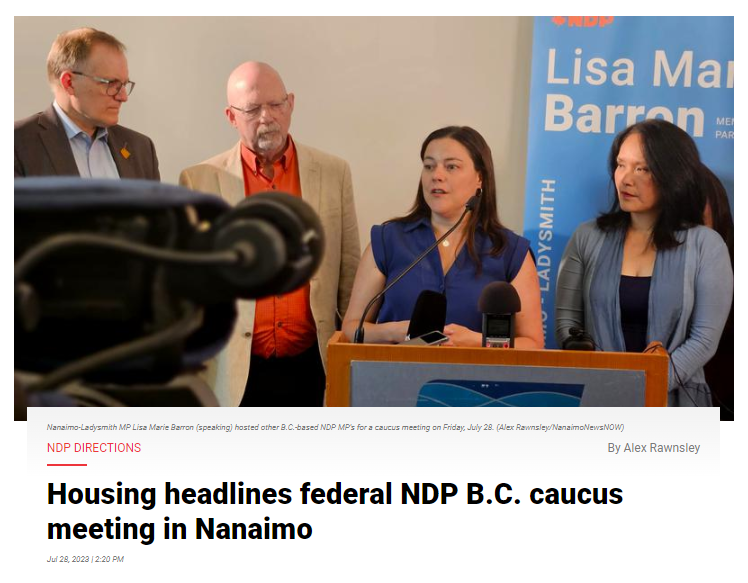
They say the problem is that not enough homes are being built and corporations are buying some of the ones that are.

“That’s why we are fighting to address the issues that we’re seeing around the financialization of housing, to see a national acquisition fund and to see a moratorium on large corporations swooping in and buying those affordable homes,” said Lisa Marie Barron, MP for Nanaimo-Ladysmith.

“The largest real estate investment trusts over the last number of years benefitted $1.7 billion that they did not pay,” said Jenny Kwan, the NDP’s Housing Critic as she criticized how corporate taxes are set up.

Barron accused the Liberals of using housing “as a commodity” while suggesting proposals from the federal Conservatives failed to look at issues around affordability.  She said a moratorium needs to be put in place to prevent corporate landlords “swooping in” to purchase low-cost units.

“We know at one point we had a government where our federal government did invest in co-op housing, social housing, we need to see that happening again.”

Barron’s comments were echoed by caucus chair and Vancouver East MP Jenny Kwan who said the issue dates back to the 1980s and 1990s when the private sector was embedded in the real estate and housing market.

“These are corporate landlords that are coming in and they started to buy up the existing, private, low-cost rental apartments. When they buy them up, it’s not like they’re fixing them up and putting them on the market at the same rate. They’re jacking up the rent, evicting people…and escalating the housing crisis.”

Interviewed by Anne Penman for The House’s summer series, Backbencher’s Backyards.  Despite someone yelling “You don’t belong here Jenny Kwan. Communist pig, go home!" while Jenny and Anne were discussing the impact of foreign interference and racism, "I know in my heart that this is not a true reflection of Van East.”

As opposition, the NDP has tried to make Parliament work for Canadians. This is in direct contrast in both substance and style to the Conservatives.

The supply-and-confidence agreement reached with the Liberals over a year ago was an exchange of promises. Under ordinary conditions, the NDP wouldn’t fold Parliament for the sake of an election if the Liberals agreed to implement some key NDP policies. The national dental plan is a direct result of that agreement: making Parliament work for Canadians.

The NDP has seen a small rise in polling numbers, but if an election were to be called this fall—or in a year from now—its actions would certainly be viewed positively by Canadians. NDP Leader Jagmeet Singh’s stature has risen as a direct result.

In an election, the Liberals would find it less than easy to condemn the NDP, with whom they have been partners. Many political disagreements make the relationship between the NDP and the Conservatives difficult. The stance on women’s abortion rights being one of them. 


OTTAWA – On Thursday, NDP Critic for Housing, Jenny Kwan (Vancouver East) and NDP Critic for Indigenous Services, MP Lori Idlout (Nunavut) secured $287.1 million for National Indigenous Collaborative Housing Incorporated (NICHI) to address the housing crisis for Urban Rural and Northern Indigenous, Metis and Inuit people leaving away from their home community. Under the Liberal government, Indigenous people are now 11 times more likely to use a shelter or live in inadequate homes than non-Indigenous people.

New Democrats have been relentlessly pushing for the government to close the funding gap. Today's announcement wouldn’t have been possible without New Democrats who forced the government to act by including support for Indigenous housing in their Confidence and Supply agreement with the Liberals.

OTTAWA – On Thursday, NDP Critic for Housing, Jenny Kwan (Vancouver East) and NDP Critic for Indigenous Services, MP Lori Idlout (Nunavut) secured $287.1 million for National Indigenous Collaborative Housing Incorporated (NICHI) to address the housing crisis for Urban Rural and Northern Indigenous, Metis and Inuit people leaving away from their home community. Under the Liberal government, Indigenous people are now 11 times more likely to use a shelter or live in inadequate homes than non-Indigenous people.

New Democrats have been relentlessly pushing for the government to close the funding gap. Today's announcement wouldn’t have been possible without New Democrats who forced the government to act by including support for Indigenous housing in their Confidence and Supply agreement with the Liberals.

“In my riding of Vancouver East, we have the third largest urban Indigenous population in the country and we have had multiple homeless encampments. Indigenous peoples are disproportionately represented among the unhoused population, yet this government has dragged its feet in providing a For Indigenous By Indigenous housing,” said Kwan. “While this is the step in the right direction, there’s more work to do.”

This announcement, pushed by New Democrats, delivers on one of the NDP’s key promises on a For-Indigenous, By-Indigenous Housing Strategy. NICHI brings together Indigenous-led housing, homelessness, and housing-related organizations to provide long-term solutions.

“Real estate investment trusts enjoy preferential tax treatment, and the seven largest REITs alone have saved a combined $1.5 billion through federal tax loopholes,” Kwan said in her private member’s bill.

The NDP is calling for a moratorium “on the acquisition of affordable homes by financialized landlords, including REITs and corporate firms” — and for REITs’ tax rebates to instead go into social housing….

On another housing front, Kwan is trying to change how tenants often find it impossible to learn the names of their landlords.

Her private member’s bill seeks to “mandate landlords to disclose property ownership,” since Kwan said many people who own rental housing hide their identities through numbered companies.
“ Yesterday, in the committee of the whole, in the questioning of the minister about this, he seemed to think that the 1% tax on the value of vacant residential real estate not owned by Canadians or Canadian residents, as well as the two-year ban on foreign investment in Canadian residential properties, is sufficient to address the housing crisis, especially as it relates to the financialization of housing.
The press asked him whether he would support and call for a moratorium on the acquisition of affordable housing from the private corporate sector or for a non-profit fund to be put in place, but he didn't answer any of those questions.

Can you advise the committee whether those two measures the government has acted on are sufficient?”

Are you ready to take action?

Contact Jenny
Mobile Offices
Constituent Resources

Sign up for updates